


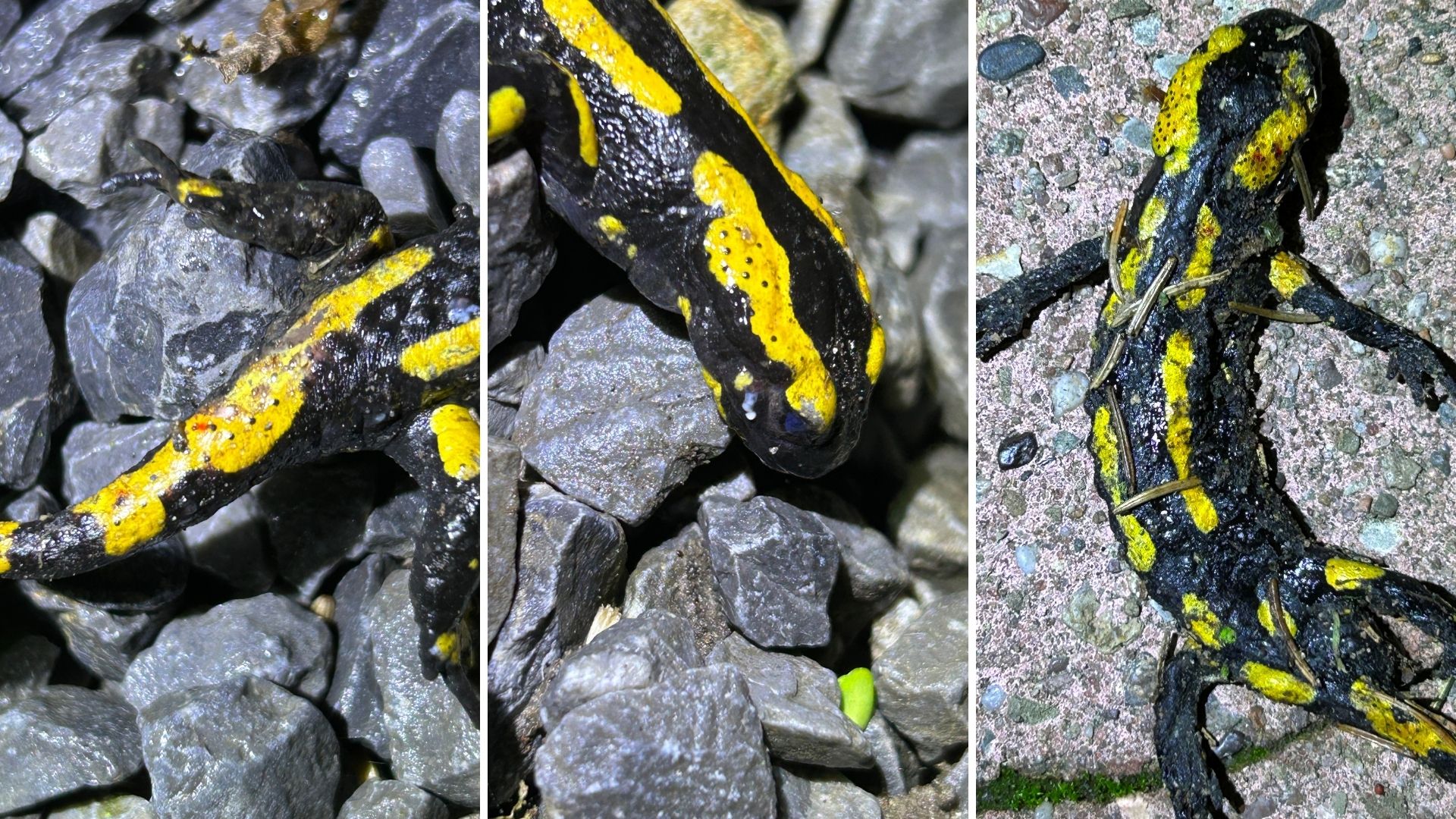
The salamander-killing fungus Bsal, which was introduced from Asia and first discovered in 2013, is responsible for the mass die-off of fire salamanders.
Starting in the tri-border region of the Netherlands, Belgium, and Germany, it has largely wiped out entire populations in the Eifel, the Ruhr region, and the Bergisches Land. According to current knowledge, every fire salamander that becomes infected dies in the wild. The fungus and its spores can survive in the habitat—at least for some time—even without a salamander host. Unfortunately, the fungus continues to spread. By the end of 2025, it had also reached Bielefeld.
In and around the Bielefeld Botanical Garden lives one of the largest known fire salamander populations in Germany, estimated at 21,000 individuals, which has also been particularly well studied scientifically. It was precisely there that, in the fall of 2025, several dozen fire salamanders were found dead from the fungal disease. There is no way to treat the disease in the wild. It therefore had to be assumed that even this famous Bielefeld salamander population would be severely affected or completely wiped out within a few years.
90% Fewer Animals Than the Previous Year
Initial population surveys conducted in the spring of 2026 by the University of Bielefeld showed that 90% fewer animals were found compared to previous years. This does not necessarily mean that a mass die-off of this magnitude has already occurred, but it does indicate significant losses, which also seems plausible. Fire salamanders often retreat to communal shelters for hibernation, where large numbers of them spend the cold season huddled closely together—an ideal environment for the fungus to spread, as it is particularly effective at spreading through direct animal-to-animal contact in cooler temperatures. It is therefore possible that a significant portion of the Bielefeld fire salamander population already died during the past winter of 2025–26, and there is reason to fear that further declines will occur. At least, however, healthy adult animals as well as numerous young larvae were still found in the spring of 2026.
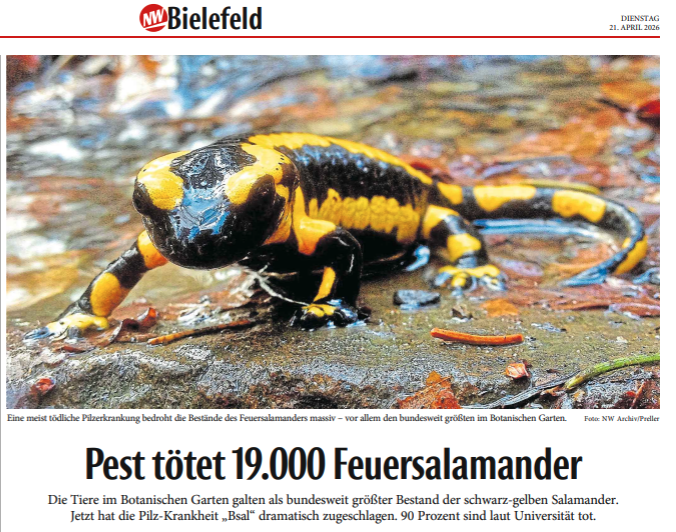
Headline of an article in the Neue Westfälische by Kurt Ehmke, published on April 21, 2026
Backup durch Erhaltungszuchten
So there is still hope for the fire salamanders in the botanical garden.
It is impossible to predict whether Bsal-infected biotopes will one day be free of the fungus again, whether habitats can be treated against Bsal, whether the fire salamanders will develop resistance to Bsal, or whether there will one day be options for prophylactic treatment or vaccination of the amphibians. For this reason, Citizen Conservation considers it necessary—in accordance with the precautionary principle—to establish fire salamander conservation breeding programs at various locations. This will allow animals that are genetically representative of the original population to be reintroduced at a later date, whether to support affected populations or to reestablish them following a possible complete or near-complete disappearance.
The techniques for the long-term successful husbandry and breeding of fire salamanders across generations are well established. In a feasibility study, Frogs & Friends comprehensively outlined the necessary, manageable effort required for this from a scientific perspective.
An Action Plan for the Bielefeld Fire Salamander
Citizen Conservation, the Wuppertal Zoo, and the University of Bielefeld have therefore jointly proposed an action plan to the City of Bielefeld. This plan includes the following three recommendations:
1) The population in the Bielefeld Botanical Garden should continue to be closely monitored and studied by the University of Bielefeld.
2) A reserve population should be established through the targeted collection of approximately 150 larvae and their rearing in human care. Appropriate housing facilities are available for this purpose, including at the Heerser Mühle Environmental Center, at Aqua Purist, in NRW partner zoos and zoos affiliated with the NRW State Zoo Association, as well as through private experts from the East Westphalia-Lippe regional group of the German Society for Herpetology and Terrarium Science (DGHT). Private donors as well as BUND Bielefeld have agreed in advance to contribute to the costs of such a measure.
3) Infected adult animals that come into human care should be treated. The Wuppertal Zoo has the capability to perform professional heat therapy, which can cure infected fire salamanders with a very good chance of success, and is making this treatment available.
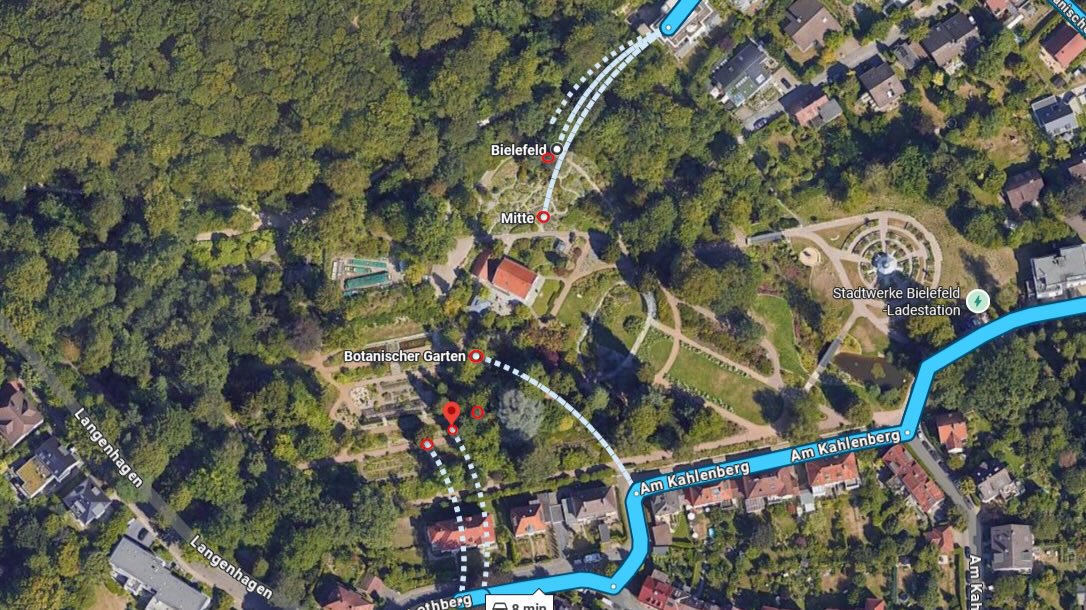
Locations of dead specimens found in the Botanical Garden © Kevin Kirste
Regrettable Rejection
On 3 June 2026, the City of Bielefeld’s Environmental Agency responded to this proposal. Whilst it agrees with and supports point 1), it rejects points 2) and 3). As the fire salamander is a specially protected species under the Federal Nature Conservation Act, the removal of animals, including larvae, is prohibited. An exemption may be granted by the Environmental Agency in justified cases. However, the City of Bielefeld’s Environmental Agency has refused to grant such an exemption. It justifies this, on the one hand, by stating that “the prospects of success for such complex ex-situ measures are entirely uncertain” and, on the other hand, by noting that “in other affected regions, it has been shown that there are populations that survive Bsal, albeit with a reduced population size where applicable”. The letter also states: “Unfortunately, it will have to be accepted that some species will be lost as a result of changes to the natural and cultural landscape.”
The Environment Agency also rejects the treatment of infected animals, pointing out that this carries the risk of spreading the pathogen and that re-release after treatment is unlikely to be successful because the fungus is still present in the habitat. Furthermore, “the integration of treated animals into an existing conservation breeding programme is not recommended, as these animals are mostly individuals that are susceptible to the fungus.”
Citizen Conservation notes the response from the Bielefeld Environmental Agency with regret and considers it misguided with regard to points 2) and 3) mentioned above.
Why Ex-Situ Measures Would Be Appropriate
The fire salamander is a species for which the Federal Republic of Germany bears special responsibility. In our view, the statement that species simply become extinct when conditions change does not do justice to this special responsibility.
In its letter, the City of Bielefeld points out that it is making intensive efforts to conserve amphibian habitats. We welcome this, but such efforts are of no use in the face of an invasive fungal disease, because the nature of the problem is entirely different. The fungus strikes even in healthy, undisturbed habitats.
It is true that it remains uncertain at present whether a subsequent reintroduction would be successful should the population become extinct. However, in our view, this cannot be a reason not to at least keep this option open. For once the population has disappeared, it will not even be possible to attempt a reintroduction using animals from this site.
In any case, however, it is certain that population-supporting measures involving the release of bred animals into the wild can have a positive effect on weakened populations. This is all the more true if, through the timely collection of founder animals for reintroduction, animals with high genetic diversity are made available to support a population that may, at a later date, be severely reduced and therefore also genetically impoverished.
Dead fire salamanders with typical skin lesions in the Bielefeld Botanical Garden © Kevin Kirste
Factual Fallacies
The City of Bielefeld’s statement that “in other affected regions, it has been shown that there are populations that survive Bsal, albeit with a reduced population size in some cases” distorts the evidence, because it remains unclear whether populations affected by Bsal are actually viable in the long term. This is because it is not known whether the—in some cases only isolated— —animals that are still found after an outbreak have migrated to the area later, survived by statistical chance, or may actually be able to live with the fungus. At the same time, it is unclear whether these populations—surviving with only a few individuals—will even persist in the long term, given the loss of genetic diversity. It is generally assumed that high genetic diversity helps species adapt to changing environmental conditions, such as those caused by climate change.
According to general expert opinion, the removal of a limited number of larvae has no measurable negative impact on a fire salamander population. Under natural conditions, larval mortality is very high. This is all the more true given that, after their transformation from the larval stage to salamanders, the animals are highly likely to contract Bsal and die. We are therefore convinced that the requirements for an exemption from the collection ban—under the special protection provided by the Federal Nature Conservation Act—are met, meaning there is no legal argument against establishing such a conservation breeding program.
Rather, in our view, the legal question that should be asked is to what extent it is justifiable under animal welfare law to “leave obviously sick animals in place,” as the City of Bielefeld recommends. This question could quickly become relevant if sick fire salamanders are, for example, found and reported by citizens or captured during monitoring activities. The City of Bielefeld’s statement that “integrating treated animals into an existing conservation breeding program is not recommended, as the animals are mostly individuals that are susceptible to the fungus” is factually incorrect. Based on current knowledge, there are no fire salamanders that are not susceptible to the fungus. On the other hand, it has been proven that a complete cure is possible through therapeutic measures when treated properly. There are no scientific concerns regarding the integration of such cured animals into conservation breeding programs.
A violation of the Convention on Biological Diversity?
This also raises the question of the extent to which the City of Bielefeld’s position—that “it will unfortunately have to be accepted” that “some species will be lost as a result of changes to the natural and cultural landscape”— can be reconciled with the obligations under the Convention on Biological Diversity (CBD)—ratified by the EU at the 1992 Earth Summit in Rio de Janeiro—as well as Germany’s obligation, as stipulated in the Nature Conservation Act, to protect the country’s biodiversity.
Article 9 of the CBD states that ex situ measures are an integral part of efforts to conserve biodiversity. They are mandatory when deemed appropriate as a supplement to the protection of a species in its natural habitat—all contracting parties, including Germany, have committed to this. This Article 9 is implemented in the EU Zoo Directive, which designates zoos as agents of the state’s obligation to provide ex situ conservation. Zoos, in turn, co-founded Citizen Conservation to effectively carry out this task and, in the case of the Bielefeld fire salamanders, even volunteered to take in animals for a conservation breeding program.
In our opinion, the Lower Nature Conservation Authority (integrated into the Environmental Office of the City of Bielefeld) cannot therefore unilaterally decide to allow a relevant population of an endangered species to become extinct if its survival in its native habitat is no longer guaranteed—which is indisputably the case for the fire salamanders in the Botanical Garden. Precisely this decision is expressly prohibited in Article 9, sections c and d of the CBD. Rather, in our view, the Lower Nature Conservation Authority would be obligated to initiate ex situ measures and corresponding removals from the wild if it itself determines that the Bielefeld fire salamander population—which can certainly be classified as relevant—is endangered.
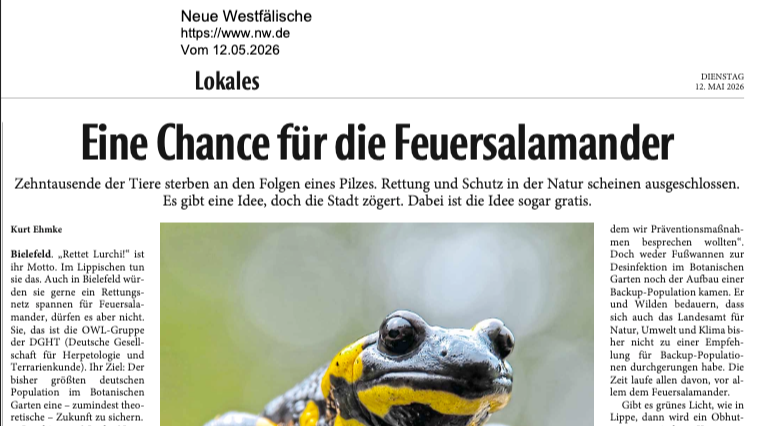
On May 12, 26, the *Neue Westfälische* reported again on the fire salamanders in Bielefeld and the offer of assistance to the city of Bielefeld.
Nothing to lose
Ex situ conservation breeding provides a proven tool for preserving and propagating members of a population over several generations, thereby ensuring the availability of “genetically authentic” animals for future population-support or reintroduction measures. The removal of founder individuals for such an ex situ conservation breeding program will have no measurable negative impact on the remaining population. A significant portion of the effort required for conservation breeding can be provided through the volunteer work of citizens and institutions such as Citizen Conservation. Furthermore, such a population in human care can yield important scientific insights, including those related to Bsal. From our perspective, therefore, there is nothing against—but a great deal in favor of—undertaking such an attempt.